SAR Denoiser
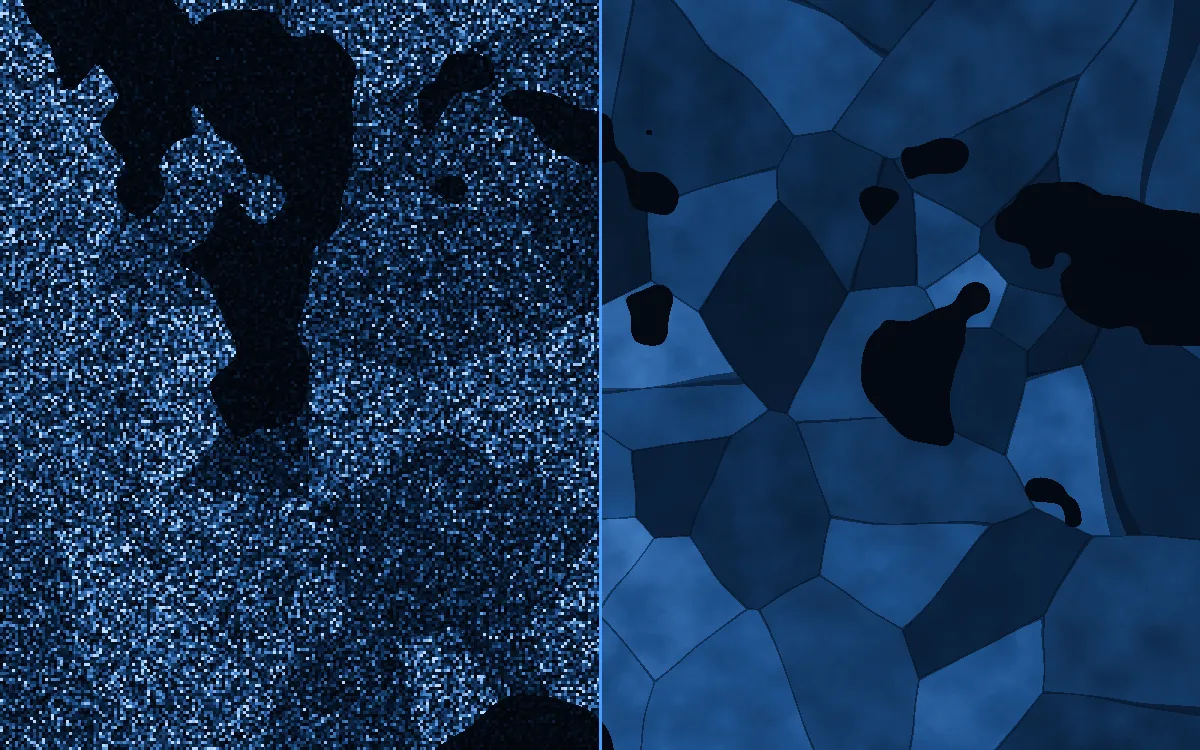
A deep learning model that cleans a single Sentinel-1 radar image in one pass, trained on real multi-temporal references instead of synthetic noise. Presented as first author at ESA INSIGHT2026.
- Role
- AI Engineer; first author and speaker at ESA INSIGHT2026
- Organization
- Starion Group
- Period
- 2025 – 2026
- SAR
- Sentinel-1
- denoising
- PyTorch
- Earth Observation
Context
Radar satellites such as Sentinel-1 see through clouds and at night, but their images are covered in speckle, a grainy noise inherent to radar imaging. At Starion Group I worked on removing it with deep learning.
I presented the work as first author in an oral talk at ESA’s INSIGHT2026 workshop (ESRIN, Frascati, May 2026): From Temporal Stacking to Single-Pass Inference: A Deep Learning Framework for SAR Denoising with Real Sentinel-1 References.
The problem
Supervised denoising needs clean targets, and a speckle-free radar image does not exist.
Approach
The key idea: use temporal stacking only to train the model, not to run it.
- Real references. For five geographic regions, 64 Sentinel-1 GRD passes of the same area over a three-year span are aligned at subpixel level (AROSICS) and averaged into a pseudo-clean reference, built only from real radar data. No synthetic speckle.
- Supervised training. Each training pair is one single acquisition and the stack of the same area.
- Single-pass inference. At deployment, one new acquisition goes through one forward pass, instead of 64 acquisitions. A single image also keeps what happens only once (a flood, a seasonal change), which a multi-year average erases.
My role
- Built the subpixel co-registration and multi-temporal stacking pipeline that generates pseudo-clean Sentinel-1 GRD references from real acquisitions (five geographic regions, 64 passes each over a three-year span), removing the dependency on synthetic speckle for supervised training.
- Trained a supervised SAR denoiser on real Sentinel-1 noisy–clean pairs: PSNR ≈ 30 dB, SSIM ≈ 0.85, EPI ≈ 0.92 on a held-out Sentinel-1 test set, with single forward-pass inference at deployment instead of 64 acquisitions.
- Evaluated the downstream effect of denoising on land-cover classification against a Lee-filter baseline.
- First author and oral presenter at the ESA INSIGHT2026 workshop.
Results
Metrics presented at ESA INSIGHT2026, on a held-out Sentinel-1 test set:
| PSNR | SSIM | SNR | ENL | EPI |
|---|---|---|---|---|
| ~30.3 dB | ~0.85 | ~25 dB | ~41 | ~0.92 |
- PSNR / SSIM: how close one pass gets to the multi-temporal stack.
- ENL (Equivalent Number of Looks): how smooth flat areas are. Higher means less speckle.
- EPI (Edge Preservation Index): how well edges survive. 1.0 means perfect.
Stack
Python · PyTorch · Rasterio · GDAL · AROSICS · Sentinel-1 GRD · Copernicus Data Space
On stage at INSIGHT2026
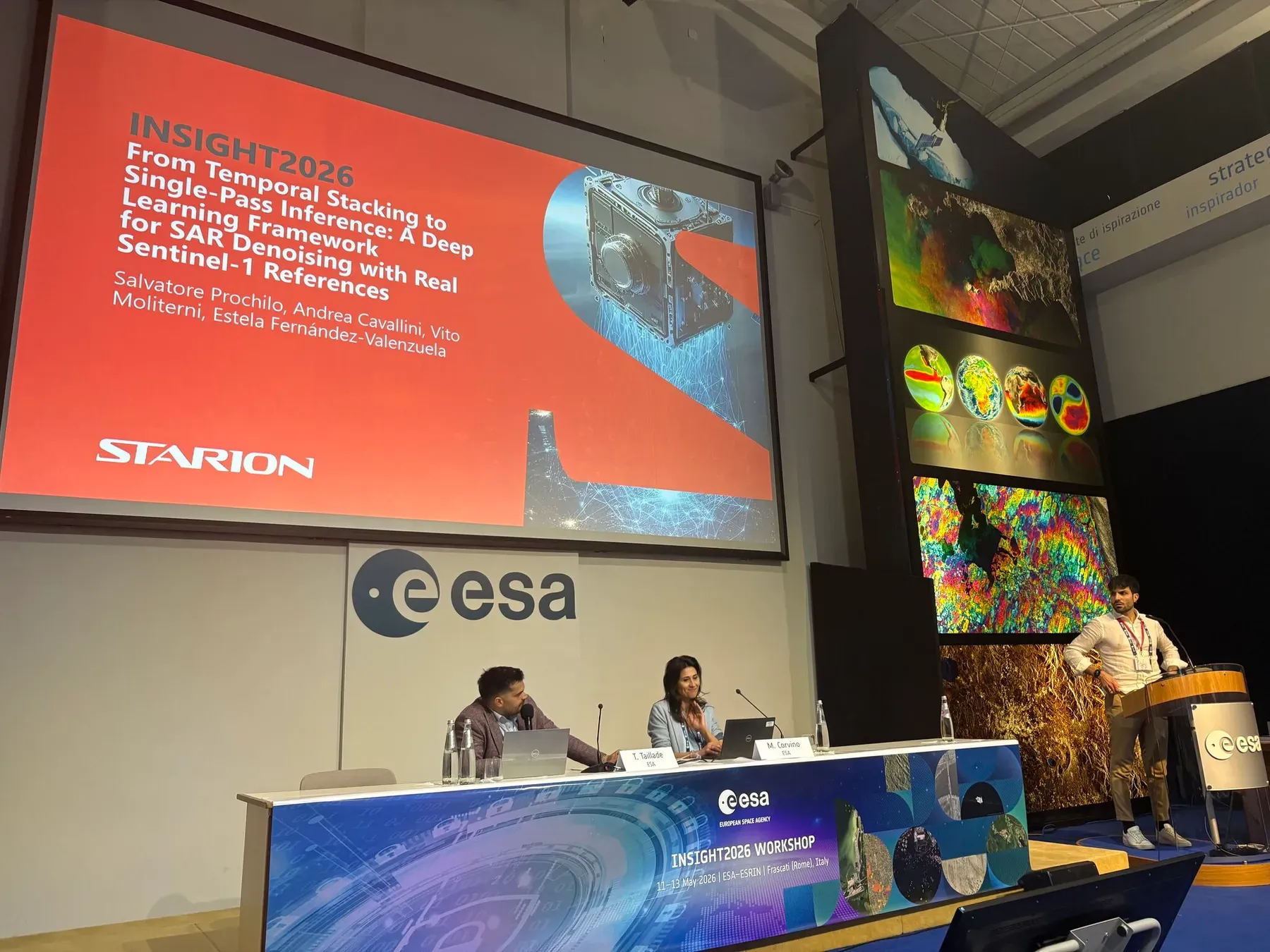
Opening the talk at ESA-ESRIN, Frascati, 12 May 2026. 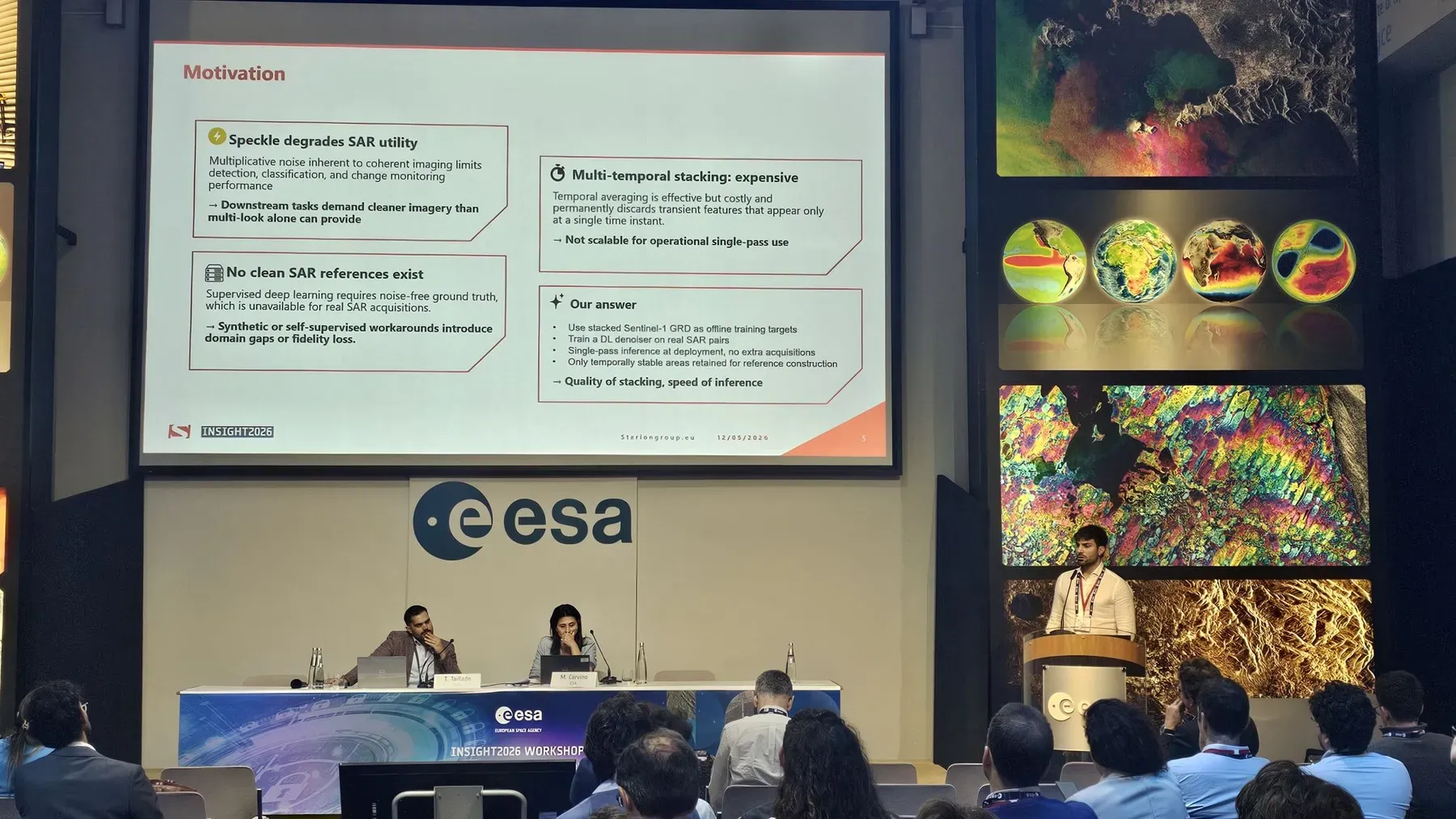
The motivation slide: why a single-pass denoiser trained on real stacked references. 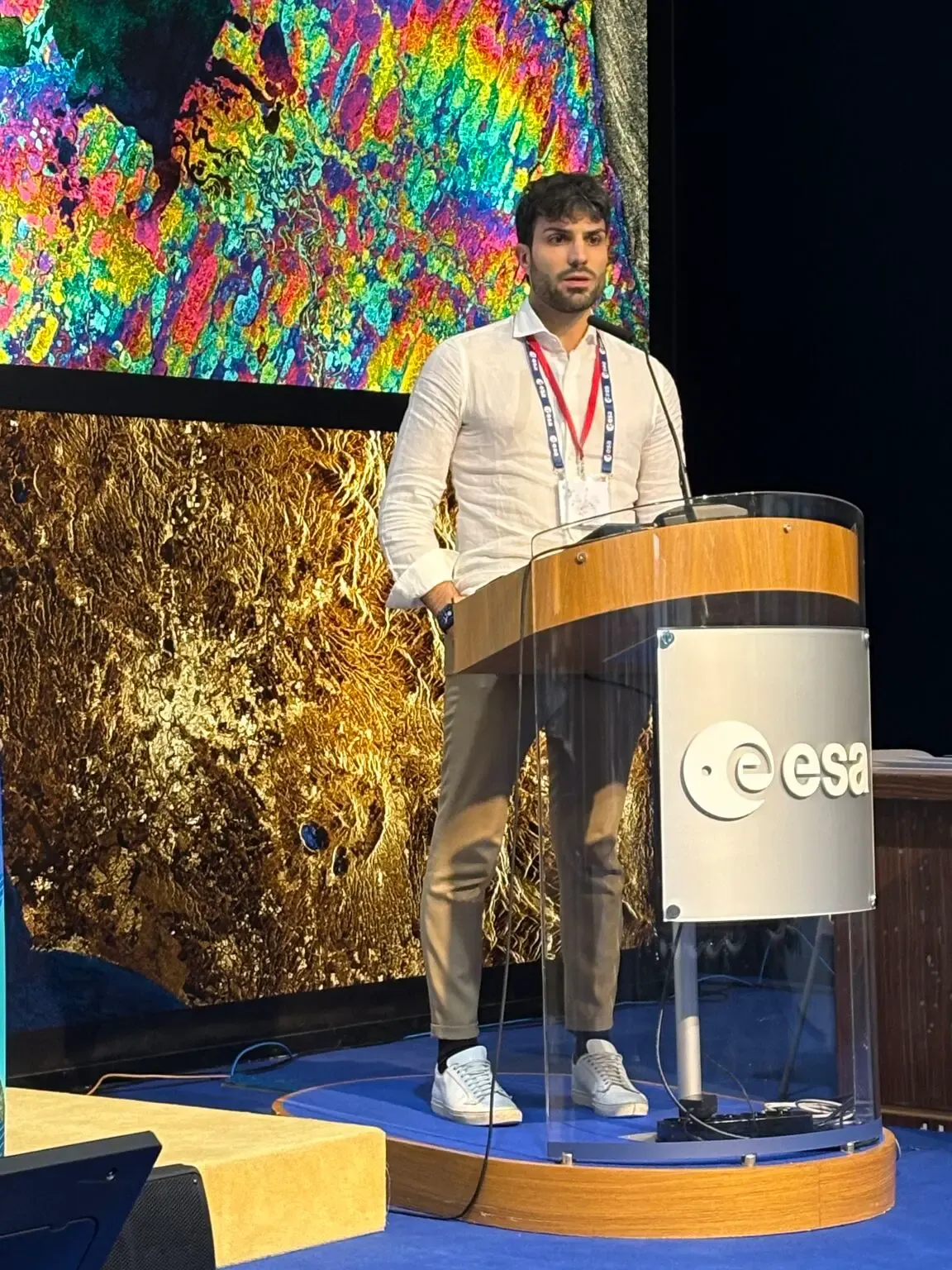
At the lectern, INSIGHT2026.